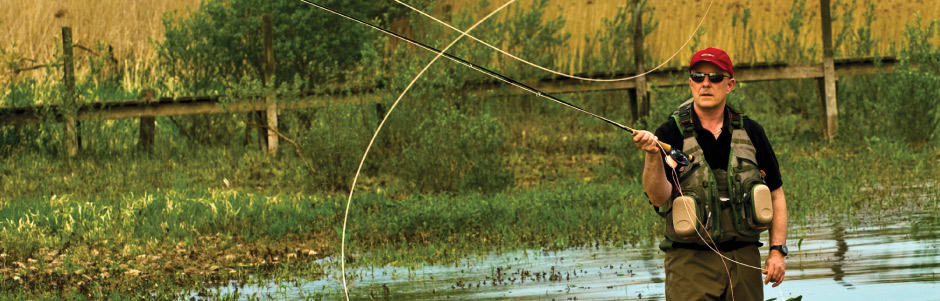
The one thing that can really make a newcomers fly fishing experience a miserable one is the lack of understanding of the fly line. Using the wrong line for the rod or using a “cheap and nasty” line can lead to hours of frustration for the angler and take all of the enjoyment out of the sport.
Fly lines are made by coating either a nylon or braid core with a PVC coating and as a general rule of thumb the more you spend on a line the smoother and slicker this coating becomes thus aiding the fly casting and shooting of the line. A cheap line will not be as supple and when pulled off of the reel will sit in tight coils at your feet. These coils of line will often be referred to as “line memory” and are a real problem when you consider you have to try and cast these coils of line through the rings of the rod.
To get a good quality line you should be looking to spend anywhere from £30 to £35 upwards. This may sound quite an outlay but a well looked after line will last the average angler a few years, so get yourself a good line and clean it on a regular basis and you will reap the rewards when it comes to casting. I spend many hoursteaching casting and even I struggle with a cheap line so you can imagine how difficult it would be for a beginner?!!
Casting with a good line makes things a whole lot easier.
Fly lines generally vary in length between 25 to 35 yards, this is attached to a thin backing line on the reel which serves two purposes. Firstly the backing line will bulk out the spool thus storing the fly line in more open coils and in turn reducing any fly line memory that may occur. Secondly the backing line acts as a reserve so if you hook a big fish that decides to go on a long run you have line in reserve should you run out of the relatively short fly line. A backing line of 20 to 30lbs breaking strain would be sufficient for most general fly fishing and should be wound onto the fly reel as neatly and as compact as possible as this will give the attached fly line a good base to be wound onto. Always aim to load as much backing onto the reel as possible just leaving enough space to fit the fly line on top, this can involve a bit of trial and error but it is worth taking the time to load your reel with line properly as you will be benefiting from this time spent over future fishing trips.
Next time I will be looking at fly line weights, densities and profiles to help you get the best from your fly fishing.
Last month I looked at how to grip the fly rod, this month I will look at how to make a fly cast and the basics of fly casting.
Now you don’t have to be a great caster to catch fish but you will catch more fish if your technique is good. For a beginner, being a good caster will not happen overnight, it will take time and practice just like any other sport, the more you cast the better your technique will become. With this in mind I would suggest if time permits that you get out with a fly rod four or five times a week, in a field will do or your back garden if it is big enough and put in about 15 minute practice sessions. Any longer than the 15 minutes will result in tired muscles and frustration and will be of no benefit. You will soon be reaping the rewards after a few weeks of practice.
Have a goal when you practice, don’t just go for out and out distance, concentrate more on technique and distance will come in time as your technique improves. Another good practice session would to be to put out some targets at various distances and practice hitting these, after a while you will be amazed at how your accuracy has improved which is a real bonus for the river fisherman trying to guide his fly into a tight spot between some overhanging bushes. Far better to practice like this than to just stand there and aimlessly make casts.
Load the rod properly……….
Don’t try and practice theroll cast on grass, it doesn’t work!! For this you need water so that the surface tension grips and anchors the “D” loop in place but grass is fine for practicing probably the more common “overhead cast”.
Here are some points to consider before your practice session:-
Always start a cast with your line straight and with no slack, if you have slack you will not load the energy into the rod and therefore the rod will not cast the line in the desired direction.
All fly casts work best under one main principle – smoothly accelerate the rod to an abrupt stop. Acceleration is needed to load the rod with energy, the abrupt stop is needed to transfer that energy down the line so making it move in the required direction.
Distance will be more easily achieved with good timing than with sheer power.
To get your hand in the right position on the back cast imagine picking up a phone to answer it, if your hand is not beside your ear it is too low.
Push your thumb towards the target on the forward cast, the rod then the line will follow your thumb.
When casting, the fly line will only ever follow the direction the rod is moving when it stops abruptly on the casting stroke, so bear this in mind when practicing your accuracy.
………and watch the line shoot to the horizon.
These are a few of the basic points to concentrate on, there are however many more but mostly to complex to try and describe in words without diagrams but drop me a line if you have any questions to do with casting.
Sea Trout fishing has always held a special place in my heart since I caught my first one some 35 years ago now, it’s infectious and once its in your system you can never get enough of that feeling of pitting your wits against this cunning fish in the pitch black of night. Night fishing isn’t for everyone but if you haven’t tried it before give it a go, its amazing how your other senses take over when you can’t see a thing in the black of the night and for night time Sea trout……the darker the better!!
Our lodge on the banks of the river Warleggan
For this years expedition I booked a riverside lodge for a week week on the river Fowey at the Wainsford Fishery. In past years I have spent a lot of time Sea Trouting in Devon rivers and also had a few trips to Wales but I had heard good reports about the Fowey so thought it was about time to tackle some Cornish Sea Trout.
The Fowey at Wainsford
As with any fishing for migratory species, good water levels are important for the fish to run up the river systems, and to my dismay on arrival, although not totally unexpected, the river level was very very low. Apart from the obvious problem of no fish running this proved to be a real problem when it came to scouting the river in daylight, a very important part of night time fishing on a water you are not familiar with, as the water was so low and clear and I would have spooked every fish in the pools and so ruined the night time fishing. Trying to avoid this I spent a lot of time on my hands and knees on the bank peaking around and through bushes, for anyone watching this must have all looked a bit odd!!
As we had not had any significant rain for a while any fish that were in the river would have been in there a while and with Wainsford being a fishing estate and fished fairly heavily, these fish would have seen all manner of offerings under their nose and would have become hard to catch but I was up for the challenge and just happy to be on the water.
The Eden Project,a great day out…….if you can stop thinking about fishing!!Had trouble matching the hatch here….it was about 20ft high!
Day times were spent visiting the local sites mixed in with messing around on the river Warleggan, a tributary to the Fowey on which our lodge was located on the banks, catching some very pretty wild Brownies.
One of the rivers “pretty brownies”
At night I would go out about 10.45 p.m. armed with two rods, one set up with a Rio Gold floating line and the other with a Rio midge Tip, in my opinion two of the very best lines on the market today. Because these lines are so good i fish with more confidence which means I fish better ultimately leading to more fish……its a mind thing but true! Casting single and double speys in the dark takes some practice but if you have a good line it makes things just a bit easier.
Wainsford fishery is split into four beats, fished on rotation throughout the week and each beat is different so keeping things interesting. There are plenty of holding pools so given the right water I could see this being a first class fishery.
The first three nights i spent without a fish although i did hear a few fish in the dark of the night and tried everything in the box from deep lures right through to surface wake lures, although fishless i was happy that I had tried everything to try and tempt any fish in front of me. Nothing worse than getting back and thinking ” what if I had tried?” I only spent one to two hours on the water each night as with just stale fish resident i did not think it would be worth flogging a pool for too long.
The fourth night arrived, i set up as usual, waded into the first pool on my beat and after twenty minutes had an arm wrenching pull on the line then all hell let loose as a powerful fish charged up and down in front of me and at one point behind me!! These fish really fight hard when hooked, you only have to look at the tail on a Sea Trout to see where the power comes from. After a 5 minute battle the fish was safely on the bank. I flicked on the head torch and was astounded to see in front of me a fish of around 3lb…..but fresh run!! The next day may have shed a little light on this.
Result………a fresh run fish.
The next morning while eating a good fry up and drinking coffee i flicked on the t.v. and watched the local news. A report came on saying that 36 hours previous there had been a tidal surge across a lot of the coast line from Plymouth down into Cornwall caused by movement in the sea bed, then followed some footage of a tidal bore making its way up one of the estuaries. Reported as a “mini tsunami”, is this what had pushed a few fresh fish up the river? I don’t know for sure but I could not think of any other reason and two more fresh fish were caught the following night so there’s every possibility this was the cause of fresh fish entering the river system.
Unlike my wading boots…….I never gave up!
The last couple of nights I had no more fish, I had a few pulls and a fish on for a few seconds on the last night but all in all I really enjoyed the trip and I will be back for more and hopefully some decent water in the river.
Saturday saw the arrival of the Burton Springs Beginners day near Bridgwater which I had set up some two months previously thinking that a June date would give us some good weather. It was an early start loading the car with all the equipment ready for the off and when I opened the front door I was met with some really heavy rain……..not what I had wanted to see.
We arrived at the fishery around 8.15 am and proceeded to set up for the days events but still in the pouring rain. Everyone started arriving around 9.30am and was greeted with tea and coffee and the day got started at 9.45 am.
I had hoped to run some of the course outside in the morning but this was just not possible due to the now monsoon type rain we getting!! Luckily Burton Springs has a lodge so we all packed into this for sessions on fly tying, entomology and knots and leaders.
Burton Springs Lodge….a haven from the bad weather!!
The weather broke just before lunch and I took everyone out onto the lake for a talk and demonstration on basic casting mechanics, 5 minutes into the demonstration the heavens opened again and we all made a dash back to the lodge for cover, it was short lived and we were all soon on the bank again to finish this session.
Getting to grips with the casting.
After lunch we were lucky as the weather seemed to get better and we were all able to get out and get into some casting before finishing up with some fishing with a few fish landed on the bank to end a great day.
One of the casting sessions.
The day was made all the better with the great people that had turned up, all of us had a good laugh and a chuckle throughout the day which helped considering the conditions we had to endure. Everyone went home with a smile on their face so I guess it was mission accomplished!!
The smile says it all!!
For everything they done to make the day a success, I would like to say a big thank you to fellow instructors Sally and Tony Pizii, Gilly for laying on all the great food for the day, taking the photos and not forgetting the home made cakes which went down well!! And finally to Adam and Dave down at Burton Springs Fishery for hosting the day and helping us make the day run smoothly.
Father & Son enjoying the fishing.
For those of you that attended the day, I would be grateful for any feedback that you can give me by filling out the message box at the bottom of this page and please feel free to copy any of the photos I have posted here.
Keep an eye out here for similar future events and come and join us on the bank.
Here are some photos of the day, please click on a thumbnail to enlarge the photo.